Why We Ranked: Inside The Ledger
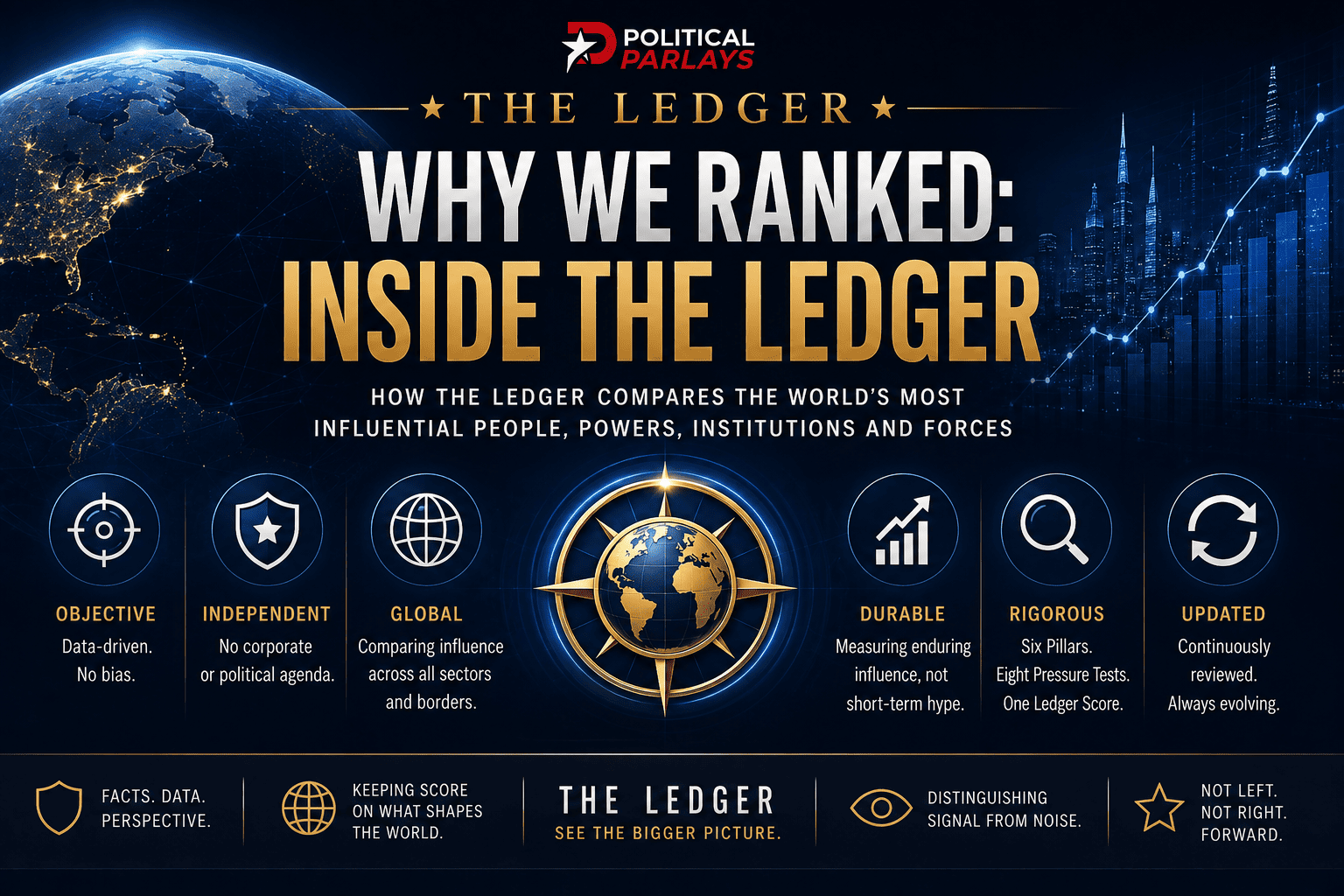
How The Ledger Compares the World’s Most Influential People, Powers, Institutions and Forces
Every ranking invites one question.
“Why?”
Why is the United States ranked above Artificial Intelligence?
Why does NATO rank ahead of the United Nations?
Why is the Federal Reserve ranked above many of the world’s largest companies?
These are exactly the questions The Ledger was built to answer.
Unlike most rankings, The Ledger does not measure popularity, wealth, military strength, GDP, market capitalization, or social media attention alone.
Instead, we ask a much broader question:
Who or what has the greatest enduring influence on the world?
That means comparing entities that rarely appear in the same conversation.
Countries.
World leaders.
Companies.
Technologies.
Financial institutions.
Government agencies.
Religious organizations.
Cities.
Political issues.
Entire industries.
Our goal is not simply to determine who is the biggest. Our goal is to determine who has the greatest ability to shape the direction of the world.
More Than a Popularity Contest
Many rankings measure a single variable.
The largest companies.
The richest people.
The strongest militaries.
The biggest economies.
The Ledger intentionally does something different.
Every entity is evaluated through our Six Pillars of Influence:
- Influence
- Power
- Momentum
- Media Presence
- Global Relations
- Sentiment
Those scores are then challenged through our Eight Pressure Tests, comparing every entity against those immediately above and below it.
Sometimes the answer is obvious.
Sometimes it is surprisingly difficult.
Why the United States Ranks Above Artificial Intelligence
Artificial Intelligence is transforming nearly every industry on Earth.
Its momentum is extraordinary.
Yet AI still depends on governments, energy infrastructure, semiconductor manufacturing, capital markets, research institutions, and national security systems.
The United States influences every one of those systems.
Today, AI remains one of the world’s most powerful technologies.
The United States remains one of the world’s most powerful architects of the environment in which AI operates.
That distinction keeps the United States ahead—for now.
Why NATO Ranks Above the United Nations
At first glance, many people assume the United Nations should outrank NATO because it has broader global membership.
But The Ledger measures influence—not membership.
The United Nations plays an essential diplomatic and humanitarian role.
NATO possesses collective military capabilities, integrated command structures, binding mutual-defense commitments, and direct influence over global security decisions.
When measured through power, decision authority, military capability, and systemic impact, NATO currently exerts greater influence over the international security environment.
Why Donald Trump Can Rank Above Apple
Apple is one of the world’s most valuable and influential companies.
Its products shape communication, software, commerce, and consumer behavior across the globe.
Yet the President of the United States possesses authorities that extend far beyond commercial influence.
A single executive decision can affect financial markets, international alliances, military operations, tariffs, immigration, regulation, and diplomacy.
Apple influences markets.
The President influences governments, markets, and global institutions simultaneously.
Those are fundamentally different forms of power.
Why the Catholic Church Remains Highly Ranked
Influence is not always measured in dollars.
For nearly two thousand years, the Catholic Church has shaped education, healthcare, diplomacy, humanitarian relief, ethics, law, and culture across every continent.
Its global institutional reach extends through thousands of dioceses, schools, hospitals, charities, and diplomatic relationships.
Although it does not command armies or financial markets, its enduring ability to influence billions of people gives it a level of global significance that few organizations can match.
Rankings Are Meant to Evolve
The Ledger is not designed to produce static rankings.
It is designed to measure a changing world.
Artificial Intelligence may rise.
Countries may gain or lose influence.
Companies may transform industries.
Political leaders come and go.
New technologies emerge.
The Ledger is intended to evolve alongside those changes while applying the same methodology consistently across every entity we rank.
This Is Only the Beginning
Every ranking tells a story.
Over time, our Why We Ranked series will take readers inside many of The Ledger’s most interesting decisions, explaining the reasoning behind controversial comparisons, major movements, and the world’s most influential people, powers, institutions, and forces.
We don’t expect everyone to agree with every ranking.
In fact, thoughtful disagreement is part of the purpose.
Our objective is not to end the conversation.
It is to create a transparent, consistent framework that helps people better understand how influence is built, exercised, and transformed in an increasingly interconnected world.