The 2030 Ledger 100
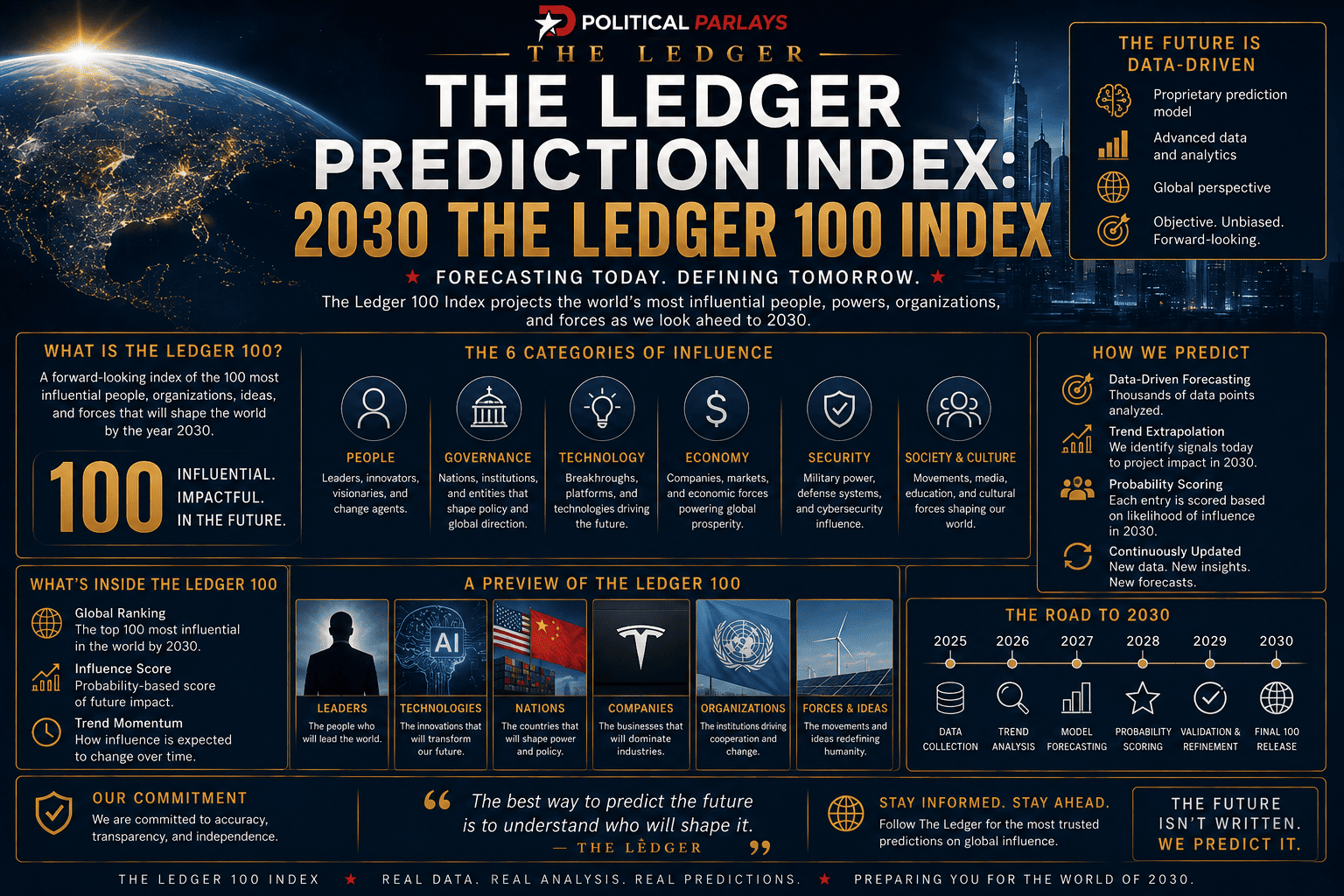
Projecting the World’s Most Influential People, Powers, Institutions and Forces
The 2030 Ledger 100 is a forward-looking projection of which people, countries, technologies, companies, institutions and forces are most likely to shape the world at the beginning of the next decade.
Unlike the current Ledger 100, this ranking places greater emphasis on trajectory.
The question is not simply:
Who is most influential today?
It is:
If current structural trends continue, who or what is most likely to possess the greatest global influence in 2030?
| Rank | Entity | Type |
|---|---|---|
| 1 | United States | Country |
| 2 | China | Country |
| 3 | Artificial Intelligence | Technology |
| 4 | India | Country |
| 5 | European Union | Supranational Power |
| 6 | Semiconductors | Technology |
| 7 | U.S. Presidency | Political Institution |
| 8 | Federal Reserve System | Financial Institution |
| 9 | Microsoft | Company |
| 10 | NVIDIA | Company |
| 11 | NATO | International Alliance |
| 12 | Quantum Computing | Technology |
| 13 | Cloud Computing | Technology |
| 14 | Saudi Arabia | Country |
| 15 | Russia | Country |
| 16 | Alphabet | Company |
| 17 | Amazon | Company |
| 18 | TSMC | Company |
| 19 | Cybersecurity | Technology |
| 20 | Apple | Company |
| 21 | Robotics | Technology |
| 22 | Biotechnology | Technology |
| 23 | Oil | Strategic Commodity |
| 24 | Nuclear Energy | Strategic Sector |
| 25 | United Nations | International Organization |
| 26 | BlackRock | Financial Institution |
| 27 | European Central Bank | Financial Institution |
| 28 | Japan | Country |
| 29 | United Kingdom | Country |
| 30 | Germany | Country |
| 31 | Space Technology | Technology |
| 32 | Natural Gas | Strategic Commodity |
| 33 | Saudi Public Investment Ecosystem | Sovereign Capital |
| 34 | Meta Platforms | Company |
| 35 | OpenAI | Company |
| 36 | Global Data Centers | Critical Infrastructure |
| 37 | Electrical Power Grids | Critical Infrastructure |
| 38 | Autonomous Systems | Technology |
| 39 | United Arab Emirates | Country |
| 40 | Indonesia | Country |
| 41 | Brazil | Country |
| 42 | South Korea | Country |
| 43 | Taiwan | Geopolitical Power |
| 44 | Global Banking System | Strategic Sector |
| 45 | U.S.–China Strategic Competition | Global Force |
| 46 | Gold | Strategic Commodity |
| 47 | Advanced Nuclear Fission | Technology |
| 48 | Gene Editing | Biotechnology |
| 49 | Digital Payments | Financial Technology |
| 50 | Global Telecommunications Networks | Critical Infrastructure |
| 51 | World Bank Group | Financial Institution |
| 52 | International Monetary Fund | Financial Institution |
| 53 | Catholic Church | Religious Institution |
| 54 | Defense Industry | Strategic Sector |
| 55 | Rare Earth Elements | Strategic Commodity |
| 56 | Copper | Strategic Commodity |
| 57 | Lithium | Strategic Commodity |
| 58 | Global Shipping & Logistics | Strategic Sector |
| 59 | Satellite Networks | Critical Infrastructure |
| 60 | Undersea Cable Networks | Critical Infrastructure |
| 61 | California | State / Province |
| 62 | New York City | Global City |
| 63 | Texas | State / Province |
| 64 | Beijing | Global City |
| 65 | Singapore | Country |
| 66 | Dubai | Global City |
| 67 | Global Pharmaceutical Sector | Strategic Sector |
| 68 | Electric Vehicles | Technology |
| 69 | Renewable Energy | Strategic Sector |
| 70 | Advanced Battery Technology | Technology |
| 71 | Synthetic Biology | Technology |
| 72 | Autonomous Vehicles | Technology |
| 73 | Drones & Unmanned Systems | Technology |
| 74 | Hypersonic Technology | Defense Technology |
| 75 | Fusion Energy | Emerging Technology |
| 76 | Semiconductor Manufacturing Infrastructure | Critical Infrastructure |
| 77 | AI Computing Infrastructure | Critical Infrastructure |
| 78 | Advanced Manufacturing | Strategic Sector |
| 79 | World Trade Organization | International Organization |
| 80 | World Health Organization | International Organization |
| 81 | OPEC | International Organization |
| 82 | Gulf Cooperation Council | Regional Organization |
| 83 | African Union | Continental Organization |
| 84 | ASEAN | Regional Organization |
| 85 | BRICS | Intergovernmental Coalition |
| 86 | Digital Identity Systems | Critical Infrastructure |
| 87 | Quantum Communications | Technology |
| 88 | Precision Medicine | Health Technology |
| 89 | Water Infrastructure | Critical Infrastructure |
| 90 | Food Security Systems | Strategic System |
| 91 | Climate Adaptation Technology | Technology |
| 92 | Space Launch Infrastructure | Critical Infrastructure |
| 93 | Cyber Defense Infrastructure | Critical Infrastructure |
| 94 | Global Payment Networks | Financial Infrastructure |
| 95 | Semiconductor Lithography | Technology |
| 96 | Advanced Materials | Technology |
| 97 | Nigeria | Country |
| 98 | Vietnam | Country |
| 99 | Mexico | Country |
| 100 | Global South Political Alignment | Geopolitical Force |
How the 2030 Projection Works
The 2030 Ledger 100 begins with the same Six Pillars used throughout The Ledger:
Influence, Power, Momentum, Media Presence, Global Relations and Sentiment.
However, the 2030 edition deliberately places additional weight on five forward-looking questions:
Trajectory
Is the entity gaining or losing influence?
Structural Growth
Are demographics, economic growth, technological adoption or institutional trends strengthening its position?
Future Dependence
Is the world becoming more dependent on the entity or system?
Strategic Scarcity
How difficult would the entity, technology or resource be to replace?
2030 Decision Authority
How much control is the entity likely to possess over major economic, political, technological or security decisions by 2030?
The Eight Pressure Tests remain unchanged:
Political Power, Economic Power, Military & Security, Technology & Innovation, Global Reach, Decision Authority, Replaceability and Systemic Impact.
What Changes Most by 2030?
The biggest projected shift is the increasing influence of technology as an independent source of power.
Artificial Intelligence, semiconductors, quantum computing, robotics, biotechnology and advanced computing infrastructure increasingly sit alongside countries and institutions rather than beneath them.
India is also projected to rise substantially as economic growth, demographics, manufacturing, technology and geopolitical importance compound over the remainder of the decade.
Energy remains critical, but the composition changes. Oil and natural gas retain enormous systemic importance while nuclear power, renewable electricity, grid infrastructure and energy storage become increasingly influential.
Critical infrastructure also rises.
Data centers, semiconductor fabrication, satellite networks, electricity grids and undersea communications cables become progressively more important as economic and national-security systems become more digital.
Editorial Standard
The 2030 Ledger 100 is not a claim that these outcomes are certain.
It is a structured projection based on current trajectories and The Ledger’s methodology.
Unexpected elections, wars, technological breakthroughs, financial crises, regulatory changes and geopolitical realignments could materially alter the rankings.
That uncertainty is part of the purpose.
The 2030 Ledger 100 asks readers to look beyond today’s headlines and consider a different question:
What will the architecture of global influence look like at the beginning of the next decade?