Why We Ranked: Comparing the World’s Great Powers
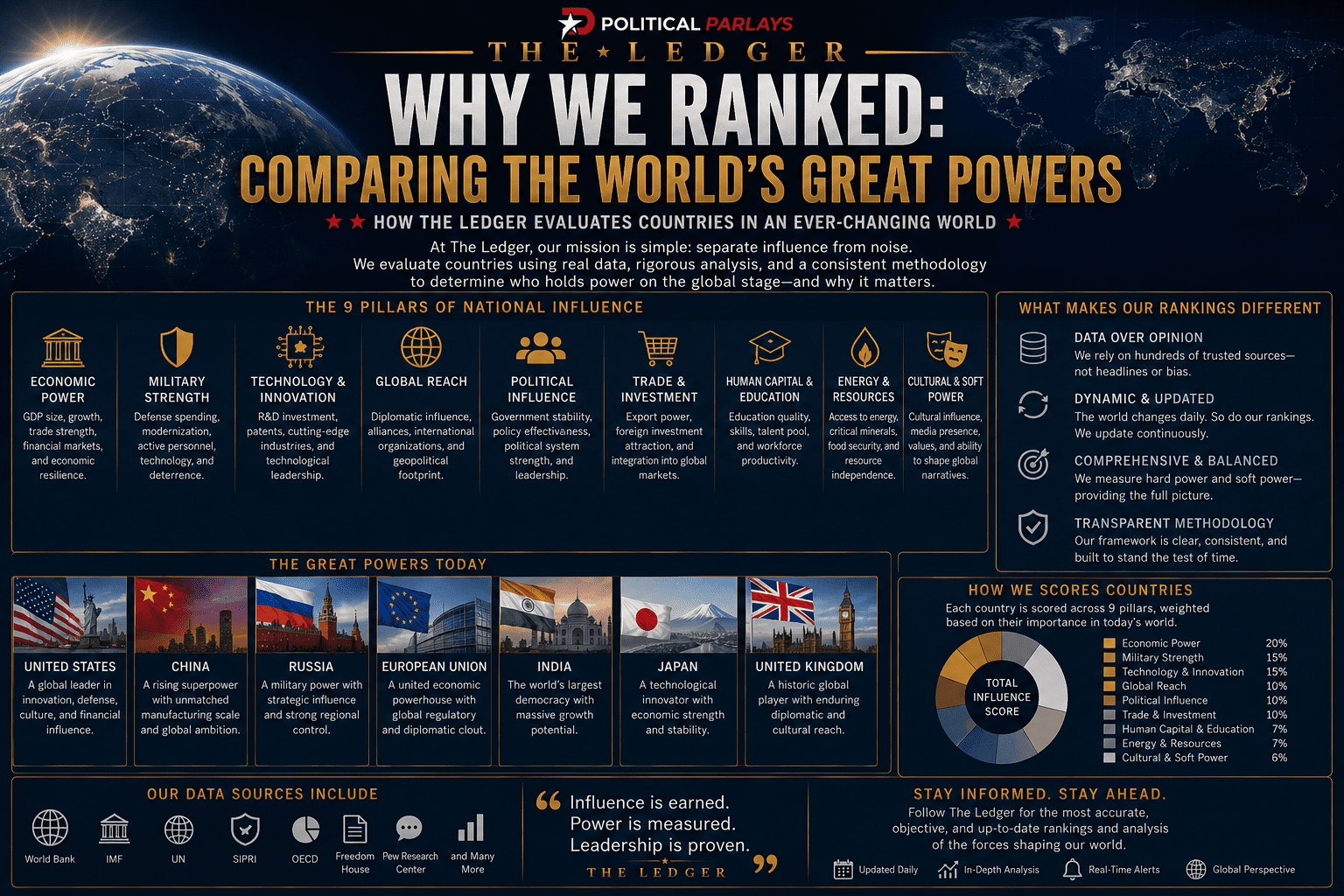
How The Ledger Evaluates Countries in an Ever-Changing World
One of the most common questions readers ask is why one country ranks above another.
Why does one nation move ahead while another falls?
Why can two countries with similar economies produce very different rankings?
The answer begins with understanding what The Ledger is—and what it is not.
The Ledger is not a ranking of GDP.
It is not a ranking of military spending.
It is not a ranking of population, geography, happiness, or political systems.
Instead, The Ledger asks a broader question:
Which countries possess the greatest enduring ability to shape the direction of the world?
That question requires looking at the entire picture.
More Than Economic Size
Economic strength remains one of the foundations of global influence.
Large economies generate investment, innovation, trade, employment, and financial power.
But history has repeatedly shown that the world’s largest economy does not automatically become the world’s most influential nation.
Economic leadership is only one part of the equation.
More Than Military Strength
Military capability remains one of the clearest forms of national power.
It shapes deterrence, alliances, regional stability, and geopolitical decision-making.
Yet military power alone rarely determines global influence.
Countries also compete through diplomacy, technology, finance, scientific research, culture, energy, manufacturing, infrastructure, education, and institutional leadership.
The Ledger attempts to evaluate how all of these forces interact.
Why Countries Rise—and Why They Fall
No country remains dominant forever.
History is defined by changing balances of power.
Economic booms.
Technological revolutions.
Demographic shifts.
Wars.
Political reform.
Financial crises.
New alliances.
Changing energy markets.
Every one of these developments can strengthen or weaken a nation’s long-term influence.
The Ledger is designed to evolve alongside those changes.
Looking Beyond Today’s Headlines
Some events dominate the news cycle.
Others reshape history.
The challenge is distinguishing between temporary momentum and lasting structural change.
A military conflict may dramatically increase a country’s visibility.
A breakthrough in artificial intelligence may strengthen another country’s technological position.
A demographic trend unfolding over decades may ultimately prove even more influential than either.
The Ledger weighs immediate developments alongside long-term structural strengths to produce a more balanced assessment.
Influence Is Multi-Dimensional
Countries exercise influence in different ways.
Some dominate finance.
Others lead technology.
Some project military power across continents.
Others shape manufacturing, energy, diplomacy, culture, or scientific discovery.
The Ledger does not assume that any single dimension should determine the final ranking.
Instead, countries are evaluated across The Ledger’s Six Pillars and tested against broader measures of resilience, adaptability, systemic impact, and global reach.
Rankings Are Designed to Change
Unlike historical monuments, rankings are not meant to remain fixed.
A country that ranks first today may not rank first a decade from now.
An emerging economy may rise rapidly.
An established power may strengthen its position.
Another may decline.
The methodology remains consistent.
The rankings evolve as the evidence evolves.
That is one of the central principles of The Ledger.
The Goal Is Consistency—Not Permanence
Every edition of The Ledger represents our best assessment based on the information available at that moment.
Reasonable people will disagree with individual rankings.
Some will believe one country should be higher.
Others will argue another deserves greater recognition.
Those debates are valuable.
What matters most is that every country is evaluated using the same transparent framework, regardless of its size, political system, alliances, or ideology.
The Ledger Perspective
The Countries Index is not intended to declare permanent winners.
It is intended to measure the evolving balance of global influence.
As nations innovate, grow, reform, compete, cooperate, and adapt, their positions will naturally change.
The rankings are a reflection of the world as it exists today—not as it existed yesterday, and not necessarily as it will exist tomorrow.
That is why The Ledger measures influence as a living system rather than a fixed hierarchy.