Why We Ranked: Sitting President vs. the State of California
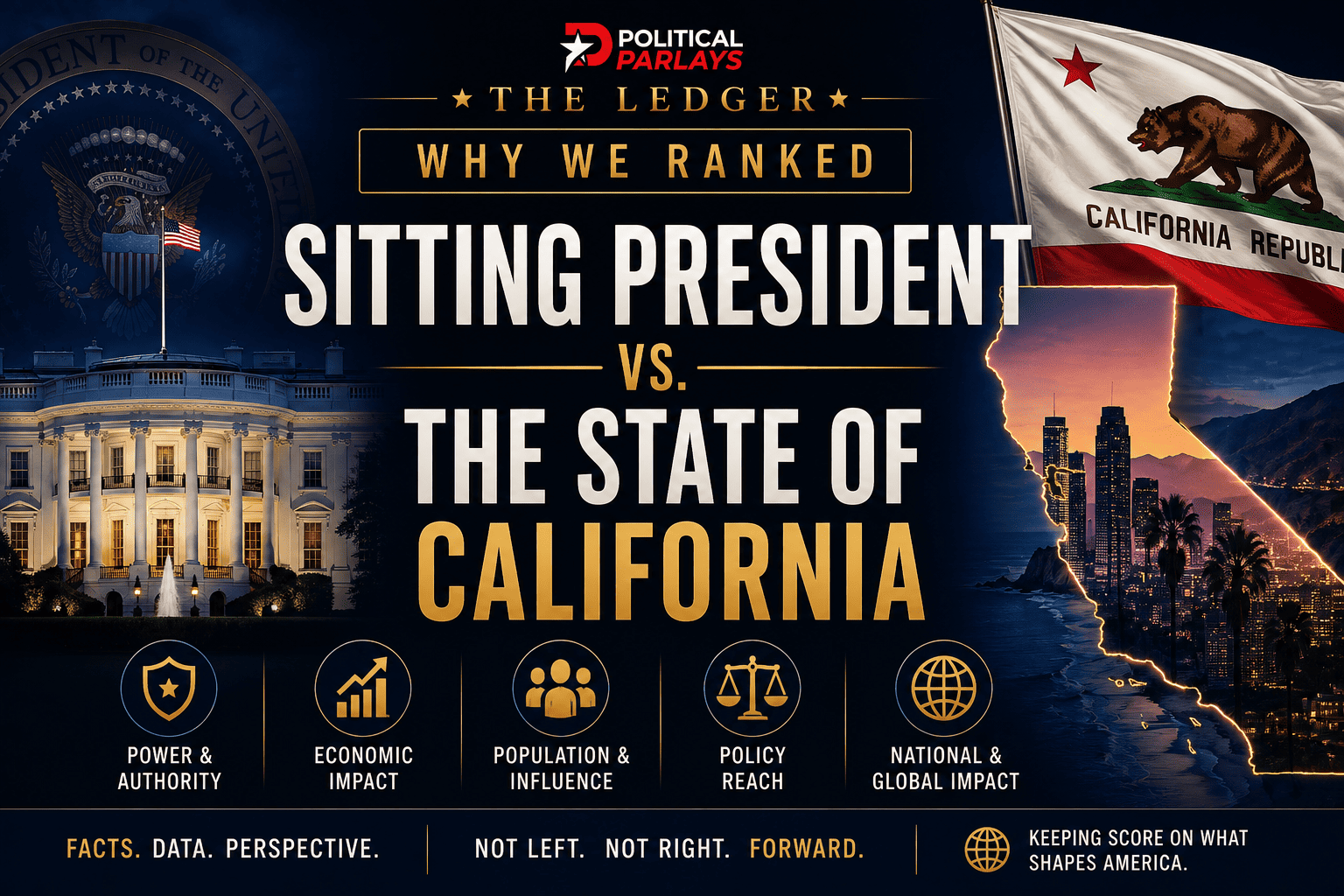
Why The Ledger Currently Ranks the Sitting President Above California
One of the most common questions readers ask is how The Ledger compares completely different types of entities.
How can an individual be ranked against a U.S. state?
Shouldn’t California, with nearly 40 million residents, one of the world’s largest economies, Silicon Valley, Hollywood, major ports, agriculture, and technological innovation, outrank any single political leader?
It’s a fair question.
California is not just America’s most influential state. If it were an independent country, its economy would rank among the largest in the world. Its influence extends across technology, entertainment, agriculture, venture capital, aerospace, higher education, and global culture. Decisions made in Sacramento often influence national policy, while companies headquartered in California help shape the future of artificial intelligence, semiconductors, biotechnology, and digital communications.
By almost any economic measure, California is a global powerhouse.
So why does Donald Trump rank higher?
The answer comes down to the difference between regional influence and national decision authority.
As President of the United States, Donald Trump possesses constitutional powers that no governor or state government can exercise. His administration influences federal taxation, trade policy, immigration, military operations, foreign affairs, tariffs, sanctions, appointments, executive orders, and relationships with allies and adversaries around the world.
A single presidential decision can immediately affect global financial markets, international diplomacy, energy prices, military posture, immigration policy, and the regulatory environment for businesses operating across every U.S. state—including California itself.
California’s influence is extraordinary, but much of it exists within the broader framework established by the federal government.
Federal monetary policy affects California.
Federal immigration policy affects California.
Federal trade policy affects California.
Federal national security decisions affect California.
California influences the United States.
The President of the United States influences California and the United States’ relationships with nearly every nation, institution, and major corporation in the world.
That distinction matters.
This does not mean California is less important.
In fact, California ranks exceptionally high within The Ledger because its influence extends far beyond state borders. Silicon Valley continues to drive global technological innovation. Hollywood shapes entertainment and culture across continents. California’s universities remain among the world’s leading research institutions, while its economy rivals that of many sovereign nations.
If California were evaluated only against other states or provinces, it would stand at or near the top.
The Ledger, however, asks a different question.
It compares every person, place, institution, technology, company, and issue using the same framework:
Who has the greatest enduring ability to shape the direction of the world?
Today, the President of the United States exercises broader decision-making authority across diplomacy, defense, international economics, federal regulation, and national policy than any individual U.S. state.
That broader reach ultimately places Donald Trump ahead of California in this edition of The Ledger.
The Ledger Verdict
California is one of the most influential subnational jurisdictions on Earth and remains a cornerstone of the global economy.
However, the President of the United States possesses wider constitutional authority, greater geopolitical reach, and more direct influence over national and international affairs.
For that reason, Donald Trump currently ranks ahead of the State of California in The Ledger’s assessment of enduring global influence.
Looking Ahead
The purpose of Why We Ranked is not to convince every reader that a particular ranking is beyond debate.
Reasonable people may disagree.
Our goal is to make every comparison transparent, consistent, and grounded in the same methodology—whether we’re comparing a country to a technology, a company to a financial institution, or a president to one of the world’s most influential states.
Every comparison is open to challenge.
Every ranking can evolve.
The methodology remains the same.