Why We Ranked: The Next U.S. President
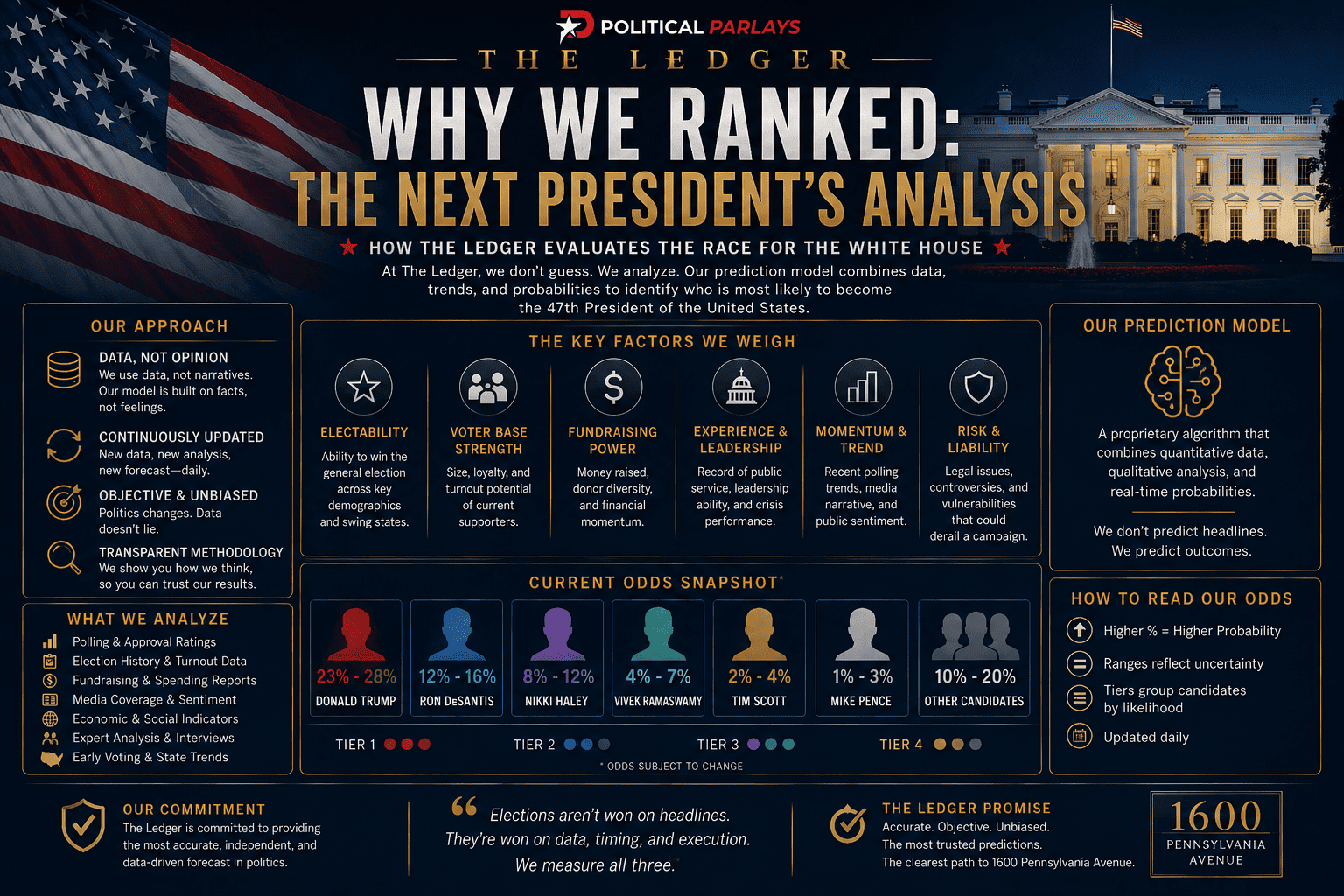
How The Ledger Evaluates the Race for the White House
Every presidential election produces endless polls, prediction markets, fundraising reports, endorsements, and political headlines.
One week a candidate surges.
The next week another falls.
The Ledger was designed to look beyond the daily news cycle.
The Next U.S. President Index is not a poll, nor is it a betting market. It is a forward-looking assessment of which individuals currently possess the strongest realistic pathway to becoming the next President of the United States.
Rather than asking “Who is leading today?”, we ask a broader question:
“Who is best positioned to win the presidency if current conditions continue?”
That distinction matters.
More Than Polling
Polling is one of the most valuable indicators in politics.
But it is only one indicator.
Candidates with early polling leads sometimes fail to secure their party’s nomination. Others begin with relatively little support before rapidly emerging as frontrunners.
The Ledger therefore combines polling with a broader assessment of political influence, institutional strength, campaign infrastructure, fundraising capacity, party dynamics, executive experience, media presence, momentum, and long-term electoral viability.
Our objective is not simply to identify who is most popular today.
It is to identify who possesses the strongest overall pathway to the presidency.
Why JD Vance Currently Ranks #1
JD Vance currently occupies one of the most advantageous positions in American politics.
As Vice President, he benefits from national visibility, executive-branch experience, daily exposure to major policy decisions, and direct proximity to the presidency.
Equally important is his position within the modern Republican Party.
Presidential nominations are rarely decided by experience alone. They are won through political coalitions.
The Republican coalition continues to be heavily shaped by Donald Trump and the movement he built. Candidates viewed as capable of inheriting that coalition begin with a structural advantage that extends beyond traditional polling.
That does not guarantee victory.
But when combined with incumbency within the administration, party influence, fundraising opportunities, and national recognition, it currently places Vance at the top of The Ledger’s assessment.
Why Marco Rubio Remains Close Behind
Marco Rubio possesses one of the strongest résumés in the potential field.
His experience spans the U.S. Senate, national campaigns, foreign policy, and executive leadership. He maintains deep relationships throughout the Republican Party while appealing to multiple wings of the conservative coalition.
In many respects, Rubio may represent one of the party’s strongest potential general-election candidates.
The question is not whether Rubio is qualified.
The question is whether anyone can realistically overtake the candidate who currently appears to have the strongest institutional and political pathway to the Republican nomination.
For that reason, Rubio remains extremely close to the top of the rankings.
Why Democratic Rankings Are More Fluid
Unlike the Republican field, where one or two figures currently possess clearer structural advantages, the Democratic landscape remains considerably more open.
Governors, senators, former cabinet officials, and nationally recognized political figures all possess plausible pathways to the nomination.
That uncertainty means Democratic candidates may experience larger ranking movements as fundraising, endorsements, debates, state-level campaigning, and primary results begin reshaping the race.
A candidate ranked fifth today could realistically be ranked first several months from now.
Why Poll Leaders Are Not Always Ranked First
One of the most common questions readers ask is why a candidate leading national polls may not automatically occupy the top position.
The answer is simple.
Winning a presidential election requires far more than leading one poll.
Candidates must secure their party’s nomination, build a national campaign organization, raise hundreds of millions of dollars, unite competing factions within their party, perform in debates, withstand intense media scrutiny, and ultimately assemble a winning Electoral College coalition.
The Ledger attempts to evaluate that entire journey rather than a single snapshot in time.
Why Rankings Change
Unlike The Ledger 100—which measures relatively enduring global influence—the Next U.S. President Index is intentionally dynamic.
Rankings may change because of:
- Primary and general-election polling
- Prediction markets
- Fundraising performance
- Major endorsements
- Debate performances
- Legislative achievements
- Economic conditions
- Supreme Court decisions
- International crises
- Candidate announcements or withdrawals
- Party consolidation
- Shifts in public sentiment
Every update reflects the latest available information alongside The Ledger’s broader methodology.
Looking Beyond the Headlines
The purpose of this index is not to predict the future with certainty.
Politics rarely follows a straight line.
Unexpected events can transform an election almost overnight.
Instead, The Ledger seeks to provide a disciplined, transparent framework for evaluating presidential prospects as they evolve.
Some readers will agree with every ranking.
Others will strongly disagree.
That debate is part of the value.
The goal is not to eliminate uncertainty—it is to provide a consistent way of assessing it.
The Ledger Verdict
The Next U.S. President Index represents The Ledger’s best forward-looking assessment of who currently possesses the strongest pathway to the presidency.
Every ranking combines measurable political data with broader assessments of influence, institutional strength, campaign viability, and party dynamics.
As campaigns evolve, the rankings will evolve with them.
Because in politics, today’s frontrunner is not always tomorrow’s nominee—and tomorrow’s nominee is not always the next President of the United States.