The Six Pillars of the Ledger Score
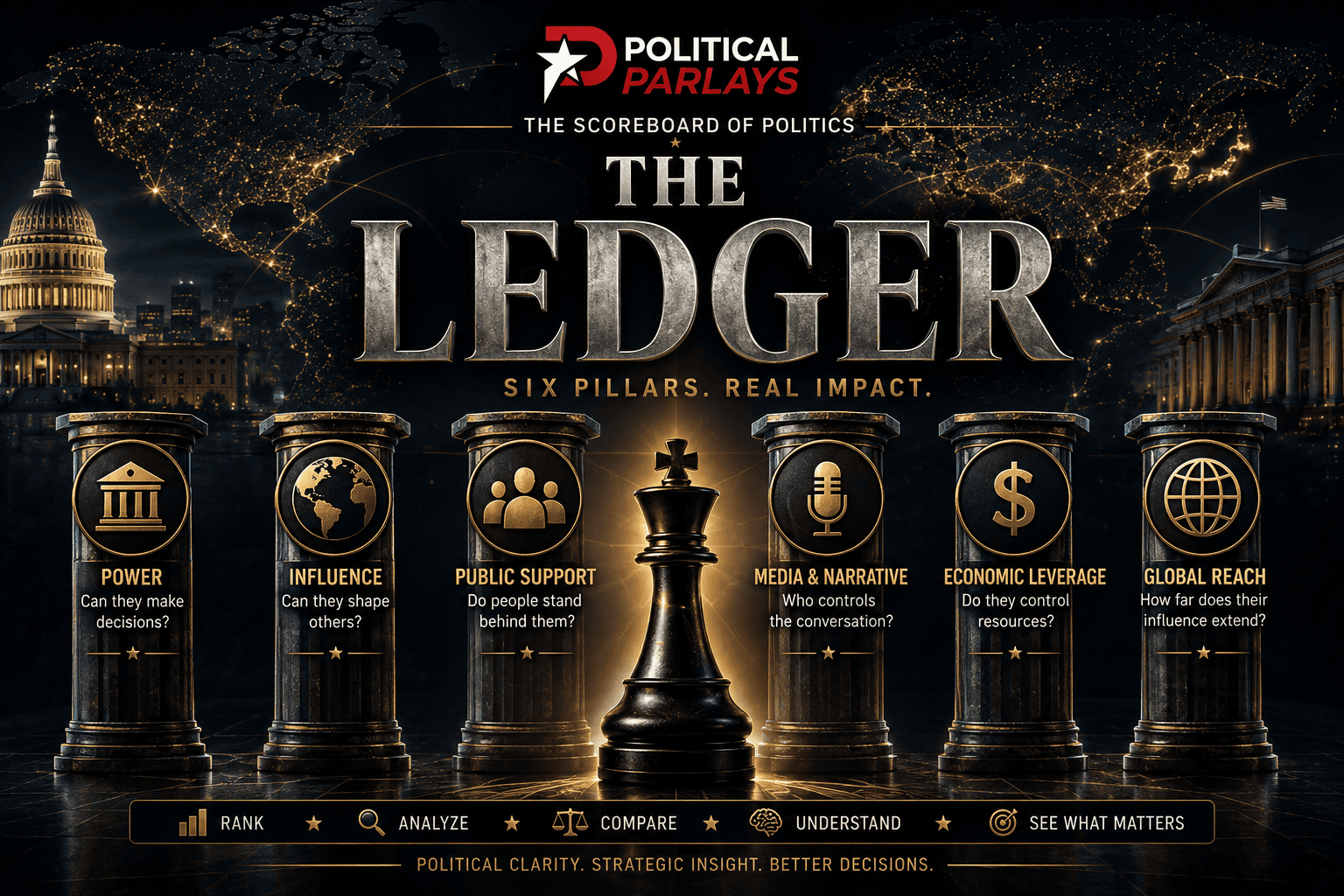
Every ranking begins with a simple question:
Who—or what—is shaping the world today?
Answering that question consistently requires more than headlines, popularity, or opinion. Governments, companies, technologies, institutions, and political leaders influence the world in fundamentally different ways. The challenge is creating a common framework that allows them to be compared objectively.
The Ledger accomplishes this through its Six Pillars of Influence. Together, these pillars produce a preliminary Ledger Score that serves as the foundation for every ranking before additional review and pressure testing.
1. Influence
How much impact does this entity have on the world?
Influence measures an entity’s ability to shape decisions, behavior, markets, public opinion, policy, or the actions of others. Unlike formal authority, influence can exist without holding office or possessing military power.
A technology company introducing a breakthrough product, a central bank signaling future policy, or a global movement changing public opinion can all exercise tremendous influence.
Ultimately, this pillar asks one question:
Does the world change because this entity acts?
2. Power
How much authority does this entity possess?
Power measures an entity’s ability to make decisions that others must respond to.
This may include executive authority, government office, military capability, economic resources, institutional control, regulatory authority, or market dominance.
While influence can persuade, power can compel.
Examples include presidents signing executive orders, central banks adjusting interest rates, corporations controlling critical infrastructure, or governments imposing sanctions.
3. Momentum
Is influence growing or declining?
Influence is never static.
Momentum measures the direction and pace of change based on recent developments, innovation, elections, legislation, financial performance, strategic initiatives, diplomatic activity, or major global events.
An entity experiencing rapid growth in importance may gain momentum even before it reaches the top of the rankings, while another may begin losing influence despite maintaining significant long-term power.
Momentum ensures The Ledger reflects both today’s reality and emerging trends.
4. Media Presence
How visible is this entity in the global conversation?
Visibility matters.
Media Presence measures how prominently an entity appears across trusted news organizations, public discussion, digital platforms, and global conversations.
Media attention alone does not determine influence, but it often reflects the importance of current events and helps explain how rapidly ideas, policies, companies, or leaders shape public awareness.
The Ledger measures visibility—not popularity.
5. Global Relations
How connected is this entity to the rest of the world?
Influence rarely exists in isolation.
Global Relations evaluates alliances, diplomatic relationships, strategic partnerships, trade networks, institutional participation, and international cooperation.
Countries strengthen influence through alliances.
Companies expand influence through global customers and supply chains.
Institutions gain influence through international participation.
This pillar measures how deeply an entity is connected to the broader global system.
6. Sentiment
How is the world responding?
Perception affects influence.
Sentiment evaluates how governments, markets, media, institutions, investors, and the public respond to an entity over time.
Positive sentiment can strengthen influence by increasing trust, confidence, cooperation, or investment.
Negative sentiment may weaken influence, create resistance, or increase uncertainty.
The Ledger does not judge whether sentiment is right or wrong—it measures whether perception is helping or hindering an entity’s ability to shape events.
One Framework. Every Entity.
Whether evaluating the United States, TSMC, NATO, Artificial Intelligence, the Federal Reserve, or a political leader, every entity begins with the same Six Pillars.
This standardized framework allows governments, companies, institutions, technologies, political leaders, and global issues to be evaluated using the same methodology, producing a consistent preliminary Ledger Score.
That score is then challenged through The Ledger’s Pressure Test process before the final ranking is published.
The result is a transparent, repeatable framework for measuring one thing:
Who—or what—is shaping the world today?