How The Ledger Updates
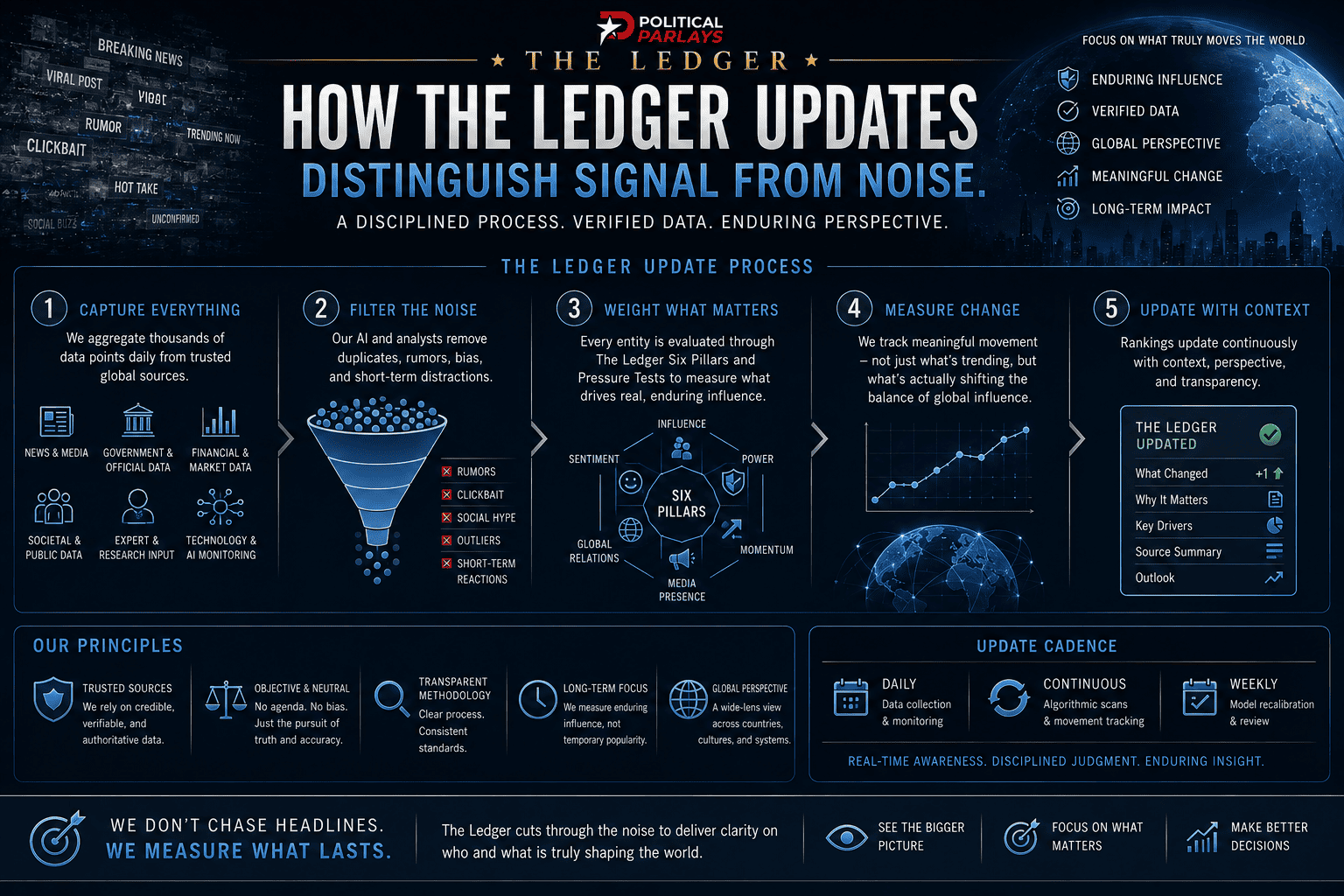
How Frequently Does the Ledger Update?
The Ledger combines AI-assisted research with human editorial oversight to measure enduring global influence, not simply the latest headline.
Although artificial intelligence continuously monitors news, public information, economic developments, corporate announcements, geopolitical events and other signals, not every new event should immediately change the world’s balance of power.
A company announcing earnings, a politician giving a speech or a market moving 2% rarely changes the long-term influence of an entity.
The Ledger is designed to distinguish signal from noise.
Daily Updates vs. Ledger Scores
The Ledger updates on two different levels.
Daily Intelligence
Every day, AI-assisted systems analyze thousands of new developments across politics, economics, business, technology, finance, national security and global affairs.
These updates may include:
- Elections
- Wars and military developments
- Legislation
- Central bank decisions
- Corporate earnings
- AI breakthroughs
- Scientific discoveries
- Diplomatic agreements
- Major acquisitions
- Market movements
- Public statements
- Regulatory actions
This continuous monitoring helps identify emerging trends and potential shifts in global influence.
Seven-Day Movement
The Movement column represents estimated momentum over approximately the previous seven days.
Rather than changing Ledger Scores daily, The Ledger estimates whether an entity’s relative influence is strengthening, weakening or remaining stable based on recent developments.
Examples include:
- ▲ +3
- ▼ -2
- ► 0
Movement reflects changes in ranking position, not changes in Ledger Score.
Ledger Scores Change Slowly
The Ledger Score measures enduring influence.
Because enduring influence develops over months and years—not hours—scores are intentionally designed to move gradually.
For example:
- The United States does not lose global leadership because of one difficult news cycle.
- NVIDIA does not become less influential because of one earnings report.
- NATO does not suddenly become weaker because of one political disagreement.
Instead, Ledger Scores evolve only when evidence suggests a meaningful structural shift has occurred.
Why Doesn’t AI Update Everything Automatically?
Artificial intelligence is exceptionally good at collecting and analyzing information.
However, influence is not determined by information alone.
Many events require context.
For example:
- Is a military strike symbolic or strategically significant?
- Does a new AI model meaningfully change the competitive landscape?
- Will a political announcement become law?
- Is a market rally temporary or the beginning of a longer trend?
The Ledger uses AI to identify important developments, summarize evidence, compare historical patterns and estimate potential effects.
The methodology then evaluates whether those developments justify a change in movement, Ledger Score or both.
The Future of The Ledger
The long-term vision is for The Ledger to become increasingly automated.
As AI reasoning, data quality and validation systems continue improving, updates will become more frequent and increasingly data-driven while preserving methodological consistency.
The goal is not simply faster rankings.
The goal is more accurate rankings.
Speed without consistency produces noise.
The Ledger prioritizes reliability over reaction.
Editorial Philosophy
The Ledger is not designed to reward whichever entity dominates today’s headlines.
It is designed to measure the enduring distribution of global influence.
Current events shape momentum.
Long-term structural power determines Ledger Scores.
That distinction is what separates The Ledger from news, opinion polls, market rankings and social media trends.