Path IV — Economic Leverage – The Eight Paths to Global Impact
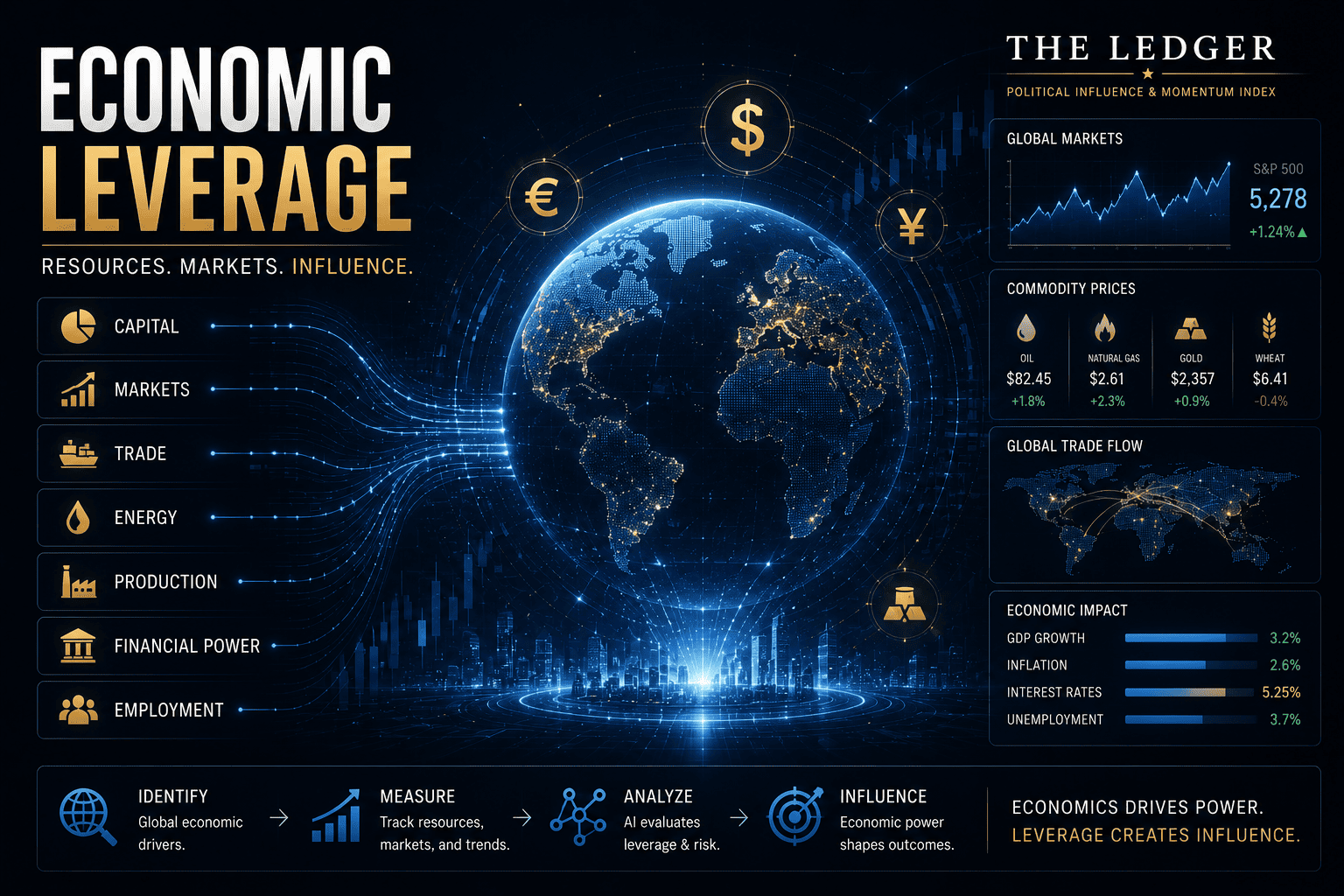
The Fourth Path to Global Impact: Economic Leverage
Money doesn’t just measure success—it creates influence.
Nearly every major global event has an economic dimension.
Interest rates influence housing markets.
Corporate investments create jobs.
Trade policies reshape supply chains.
Energy prices affect inflation.
Sanctions alter international relations.
Capital flows determine where innovation happens next.
While politics often dominates the headlines, economics quietly determines what is possible.
That is why The Ledger asks another critical question:
Who has the financial capacity to shape decisions beyond their own organization?
Economic leverage is not simply about wealth.
It is about the ability to influence markets, industries, governments, institutions, and society through financial resources and economic decision-making.
What Is Economic Leverage?
Economic Leverage measures an entity’s ability to influence others through financial strength, capital allocation, market participation, or control over economic resources.
It reflects the power that comes from controlling or directing money—not merely possessing it.
Economic leverage can affect:
- Global markets
- National economies
- Business investment
- Employment
- Consumer spending
- Innovation
- Trade
- Financial confidence
In many cases, financial decisions produce consequences that extend far beyond balance sheets.
Why Economic Leverage Matters
Economics influences nearly every aspect of modern life.
Companies decide where to invest.
Governments determine spending priorities.
Central banks influence borrowing costs.
Investors allocate trillions of dollars.
Businesses hire—or reduce—their workforce.
Consumers adjust spending based on prices and confidence.
These decisions ripple through economies, affecting millions of people.
The greater an entity’s ability to shape those outcomes, the greater its Economic Leverage.
How AI Measures Economic Leverage
The Ledger evaluates a wide range of publicly observable economic indicators to understand an entity’s capacity to influence financial outcomes.
Signals may include:
Financial Scale
Revenue
Assets
Market capitalization
GDP
Budget size
Capital Allocation
Investment activity
Research and development
Infrastructure spending
Acquisitions
Strategic funding
Market Influence
Industry leadership
Supply chain importance
Pricing power
Market share
Economic concentration
Employment Impact
Workforce size
Hiring trends
Job creation
Regional economic importance
Financial Connectivity
Global trade relationships
Investment partnerships
Capital flows
Cross-border economic influence
Rather than focusing on a single number, The Ledger evaluates how financial resources translate into real-world influence.
Wealth Is Not Economic Leverage
Having significant wealth does not automatically create broad economic influence.
A private individual may possess enormous personal assets while having relatively little effect on markets or institutions.
Conversely, a central bank, multinational corporation, sovereign wealth fund, or government agency may influence global financial conditions through policy or investment decisions.
The Ledger measures economic impact—not personal net worth.
Economic Leverage Evolves
Financial influence changes continuously.
A merger.
An earnings report.
A recession.
A technological breakthrough.
A change in interest rates.
A major investment.
A new trade agreement.
Each event can strengthen—or weaken—an entity’s ability to shape economic outcomes.
The Ledger continuously reevaluates these changes as new information becomes available.
Examples of Strong Economic Leverage
Economic leverage exists across many sectors.
Examples include:
- Central banks
- National governments
- Global corporations
- Institutional investors
- Major technology companies
- Energy producers
- Financial institutions
- Sovereign wealth funds
Economic influence is not limited to finance.
Any entity capable of materially affecting markets, employment, investment, or economic confidence may possess significant Economic Leverage.
Why Economic Leverage Is Only One Path
Financial strength alone does not determine someone’s overall Ledger Score.
A company may generate enormous revenue while receiving little public support.
A government may control a large economy while losing political momentum.
A public figure may influence millions without controlling significant financial resources.
That is why The Ledger evaluates multiple dimensions together.
Economic Leverage is only one of the Eight Paths to Global Impact.
Together, these paths provide a more complete picture of who is shaping the world—and why.
Economic Leverage measures financial influence.
Not personal wealth.
Not stock price alone.
Not headline valuation.
It reflects an entity’s ability to shape markets, direct capital, influence investment, and affect economic outcomes on a meaningful scale.
Because in a connected global economy…
Financial decisions often become global decisions.