The Ledger 2030 Business Leaders Index
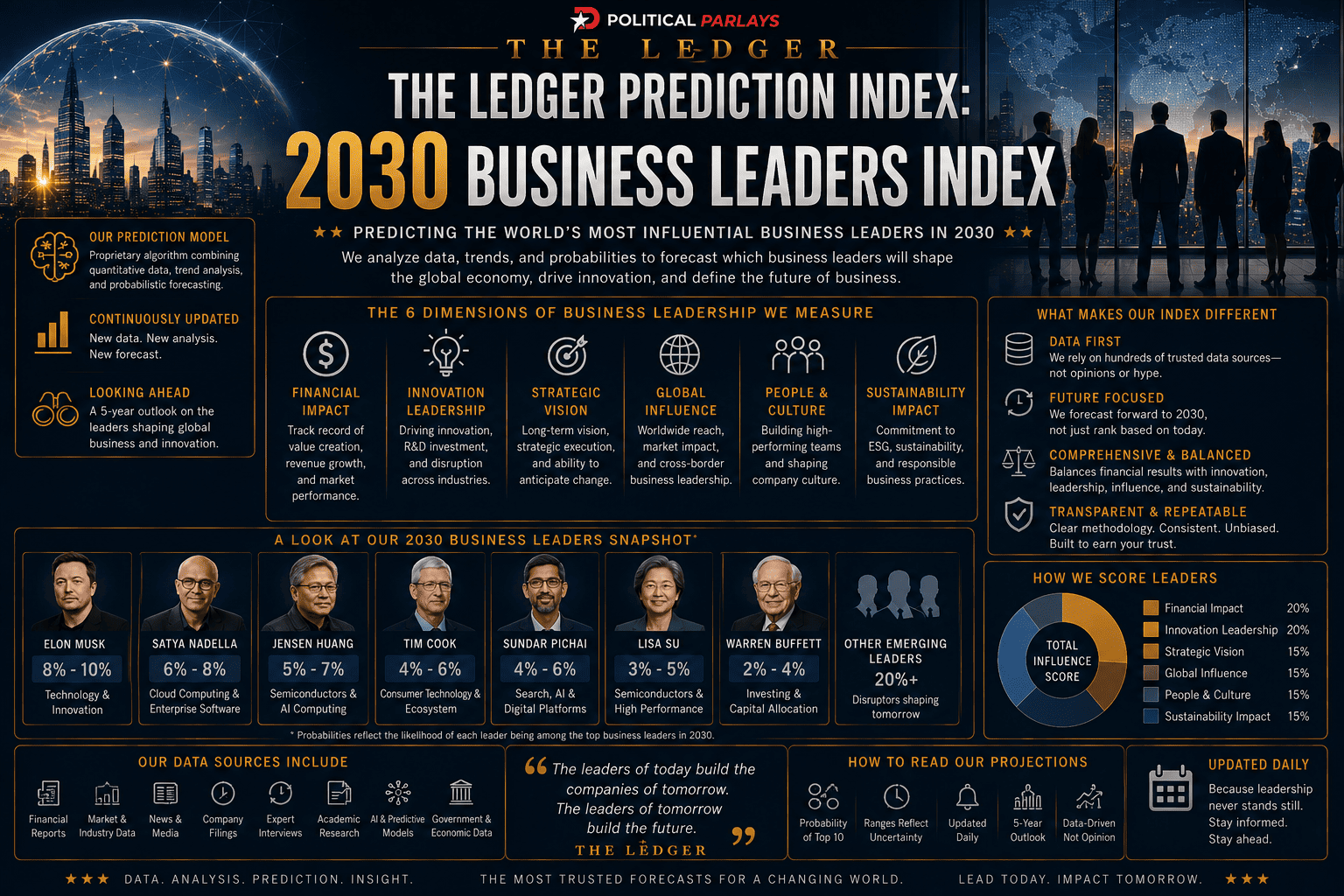
Top 100 Business Leaders Most Likely to Shape the Next Decade
The Ledger 2030 Business Leaders Index projects which executives, founders, investors and innovators are most likely to exert the greatest influence over global business by the beginning of the next decade.
Unlike the current Business Leaders Index, this ranking gives greater weight to trajectory, technological leverage, founder control, strategic industries, capital allocation, institutional durability and the likelihood that the individual remains highly influential through 2030.
| Rank | Business Leader | Primary Platform / Influence |
|---|---|---|
| 1 | Jensen Huang | NVIDIA / AI Computing |
| 2 | Elon Musk | SpaceX / Tesla / xAI |
| 3 | Sam Altman | OpenAI / Artificial Intelligence |
| 4 | Satya Nadella | Microsoft |
| 5 | Mark Zuckerberg | Meta |
| 6 | Sundar Pichai | Alphabet / Google |
| 7 | Demis Hassabis | Google DeepMind |
| 8 | Dario Amodei | Anthropic |
| 9 | Lisa Su | AMD |
| 10 | Alex Karp | Palantir |
| 11 | Jeff Bezos | Amazon / Blue Origin / Investment |
| 12 | Larry Ellison | Oracle |
| 13 | Andy Jassy | Amazon |
| 14 | Tim Cook | Apple |
| 15 | Palmer Luckey | Anduril |
| 16 | Masayoshi Son | SoftBank |
| 17 | Mukesh Ambani | Reliance Industries |
| 18 | Larry Fink | BlackRock |
| 19 | Jamie Dimon | JPMorgan Chase |
| 20 | Wang Chuanfu | BYD |
| 21 | Pony Ma | Tencent |
| 22 | Zhang Yiming | ByteDance |
| 23 | Lei Jun | Xiaomi |
| 24 | Ren Zhengfei | Huawei |
| 25 | Robin Zeng | CATL |
| 26 | Gautam Adani | Adani Group |
| 27 | Bernard Arnault | LVMH |
| 28 | Brian Armstrong | Coinbase |
| 29 | Changpeng Zhao | Crypto / Binance Ecosystem |
| 30 | Michael Dell | Dell Technologies |
| 31 | Cristiano Amon | Qualcomm |
| 32 | Shantanu Narayen | Adobe |
| 33 | Arvind Krishna | IBM |
| 34 | Safra Catz | Oracle |
| 35 | Marc Benioff | Salesforce |
| 36 | Dara Khosrowshahi | Uber |
| 37 | Brian Chesky | Airbnb |
| 38 | Daniel Ek | Spotify |
| 39 | Evan Spiegel | Snap |
| 40 | Patrick Collison | Stripe |
| 41 | John Collison | Stripe |
| 42 | Tobi Lütke | Shopify |
| 43 | Melanie Perkins | Canva |
| 44 | Dylan Field | Figma |
| 45 | Alexandr Wang | AI / Government Technology |
| 46 | Aravind Srinivas | Perplexity |
| 47 | Arthur Mensch | Mistral AI |
| 48 | Mustafa Suleyman | Microsoft AI |
| 49 | Fei-Fei Li | World Labs / AI |
| 50 | Andrew Ng | AI / Education / Venture |
| 51 | Fidji Simo | AI / Consumer Technology |
| 52 | Bret Taylor | Sierra / AI |
| 53 | David Baszucki | Roblox |
| 54 | Jensen Huang’s eventual NVIDIA successor | AI Computing |
| 55 | Peter Thiel | Venture Capital / Defense Technology |
| 56 | Marc Andreessen | Andreessen Horowitz |
| 57 | Ben Horowitz | Andreessen Horowitz |
| 58 | Reid Hoffman | Venture Capital / AI |
| 59 | Vinod Khosla | Khosla Ventures |
| 60 | Cathie Wood | ARK Invest / Innovation Capital |
| 61 | Stephen Schwarzman | Blackstone |
| 62 | David Solomon | Goldman Sachs |
| 63 | Ted Pick | Morgan Stanley |
| 64 | Jane Fraser | Citigroup |
| 65 | Brian Moynihan | Bank of America |
| 66 | Adena Friedman | Nasdaq |
| 67 | David Ricks | Eli Lilly |
| 68 | Albert Bourla | Pfizer |
| 69 | Stéphane Bancel | Moderna |
| 70 | Reshma Kewalramani | Vertex Pharmaceuticals |
| 71 | Robert Ford | Abbott |
| 72 | Joaquin Duato | Johnson & Johnson |
| 73 | David Gitlin | Carrier / Climate Infrastructure |
| 74 | Tricia Griffith | Progressive |
| 75 | Mary Barra | General Motors |
| 76 | Jim Farley | Ford |
| 77 | Oliver Blume | Volkswagen / Porsche |
| 78 | Ola Källenius | Mercedes-Benz |
| 79 | Toshiaki Mikoshiba / Toyota leadership | Toyota |
| 80 | Christian Klein | SAP |
| 81 | Roland Busch | Siemens |
| 82 | Peter Wennink’s ASML leadership successor | Semiconductor Equipment |
| 83 | Christophe Fouquet | ASML |
| 84 | C.C. Wei | TSMC |
| 85 | Young Liu | Foxconn |
| 86 | Lip-Bu Tan | Intel |
| 87 | Sanjay Mehrotra | Micron |
| 88 | Hock Tan | Broadcom |
| 89 | George Kurtz | CrowdStrike |
| 90 | Nikesh Arora | Palo Alto Networks |
| 91 | Matthew Prince | Cloudflare |
| 92 | Jayshree Ullal | Arista Networks |
| 93 | Gwynne Shotwell | SpaceX |
| 94 | Peter Beck | Rocket Lab |
| 95 | Will Marshall | Planet Labs |
| 96 | Tim Ellis | Relativity Space |
| 97 | Brett Adcock | Figure AI |
| 98 | Brett Adcock / next-generation humanoid robotics leadership | Robotics |
| 99 | Alexandr Agapitov / emerging digital-economy leadership | Digital Platforms |
| 100 | An Unidentified Founder Building a 2030 Category Leader | Emerging Business |
How the 2030 Ranking Differs
The present-day Business Leaders Index asks:
Who exercises the greatest business influence today?
The 2030 Business Leaders Index asks:
Who is most likely to shape the architecture of global business by 2030?
That means a younger founder controlling an emerging strategic platform can rank ahead of a much wealthier executive whose influence is mature or declining.
The 2030 edition therefore places additional emphasis on:
Trajectory — Is the leader’s influence accelerating?
Founder or Strategic Control — Can they make consequential decisions without being easily replaced?
Industry Position — Are they operating in AI, semiconductors, defense, energy, biotechnology, finance, robotics, space or another sector likely to gain strategic importance?
Capital Access — Can they direct billions of dollars toward new technologies, companies and infrastructure?
Talent Magnetism — Can they attract the scientists, engineers, executives and investors necessary to build the next generation of companies?
Institutional Durability — Is their influence likely to survive market cycles, leadership changes and technological disruption?
The Six Pillars
Every leader is still evaluated through:
Influence
Power
Momentum
Media Presence
Global Relations
Sentiment
The Eight Pressure Tests remain:
Political Power
Economic Power
Military & Security
Technology & Innovation
Global Reach
Decision Authority
Replaceability
Systemic Impact
Editorial Standard
The Ledger 2030 Business Leaders Index is a forward-looking projection, not a prediction of personal wealth or company market capitalization.
Rankings estimate which individuals are most likely to shape global business, technology, capital, industry and innovation as the world approaches 2030.
Unexpected technological breakthroughs, corporate failures, succession decisions, acquisitions, regulation, health events and entirely new companies may materially change the rankings.