How The Ledger Pressure Tests Every Ranking
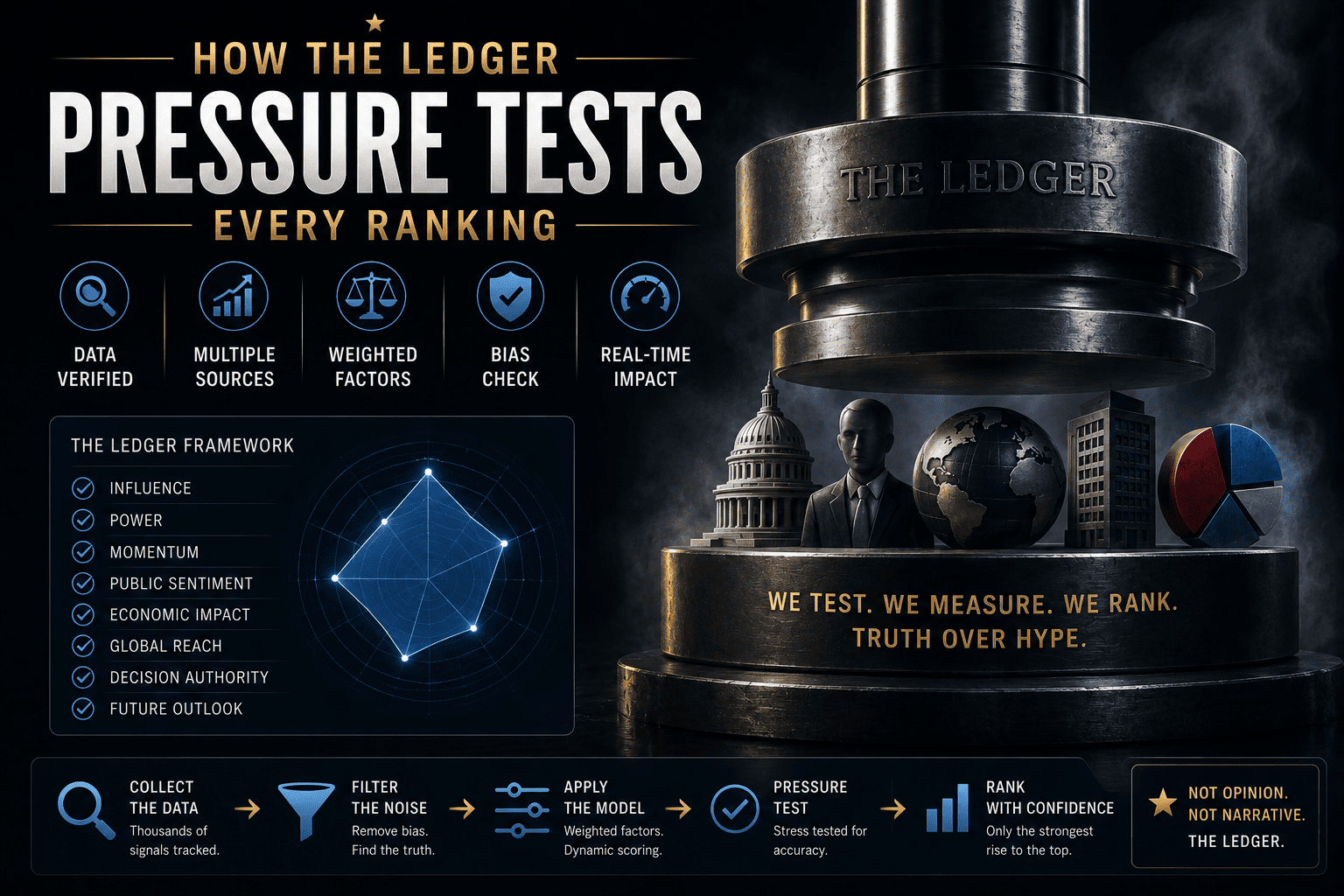
How The Ledger Pressure Tests Every Ranking
One of the biggest challenges with any ranking system is consistency.
Most rankings tell you where something ranks. Very few explain why.
At The Ledger, every entity is evaluated through the same structured process, whether it is a country, political leader, company, technology, institution, industry, or global issue.
The goal is not to reward popularity or overreact to the latest headline. The goal is to measure enduring global influence through a repeatable, AI-assisted methodology.
Every Entity Is Scored the Same Way
The Ledger begins by evaluating each entity across its Six Pillars:
| Pillar | Weight | What It Measures |
|---|---|---|
| Influence | 20% | The ability to shape decisions, markets, public opinion, policy, or the actions of others |
| Power | 20% | Formal authority, institutional control, economic strength, military capability, and available resources |
| Momentum | 15% | Whether an entity’s influence is rising, stable, or declining |
| Media Presence | 15% | Visibility across trusted news sources, public discussion, and global media coverage |
| Global Relations | 15% | Alliances, partnerships, diplomatic relationships, and international positioning |
| Sentiment | 15% | How the entity is perceived by the public, media, institutions, and other stakeholders |
Together, these Six Pillars produce a preliminary Ledger Score between 0 and 100.
That score creates a common framework for comparing entities that may exercise influence in very different ways.
Comparing Different Types of Influence
Consider ExxonMobil and Samsung.
Samsung derives much of its influence from technology, consumer electronics, semiconductor production, international reach, and innovation.
ExxonMobil derives its influence from global energy markets, infrastructure, capital investment, government relationships, supply chains, and the broader importance of oil and gas to the global economy.
The Ledger does not ask which company is larger, more popular, or more innovative.
It asks:
Which entity currently possesses the greater overall and more enduring global influence?
The Six Pillars establish the preliminary answer. The Pressure Test determines whether that answer can be defended.
The Eight Pressure Tests
Scoring is only the first step.
Every preliminary ranking is then challenged using eight measures of enduring global influence:
| Pressure Test | Key Question |
|---|---|
| Political Power | Can it create or materially influence laws, treaties, sanctions, wars, or public policy? |
| Economic Power | Does it influence trade, capital flows, financial markets, investment, or the global economy? |
| Military & Security | Can it project military, intelligence, defense, or security influence? |
| Technology & Innovation | Does it control or shape critical technologies, infrastructure, or future industries? |
| Global Reach | How broadly does its influence extend across countries, industries, and institutions? |
| Decision Authority | Can it make decisions that governments, businesses, markets, or populations must respond to? |
| Replaceability | Could the world replace it without major disruption? |
| Systemic Impact | How significantly would the global system change if it disappeared or lost its influence? |
These tests do not replace the Six Pillars or create a second independent score.
They challenge the preliminary score and help determine whether the entity’s position holds up against its closest competitors.
The Real Pressure Test
After the preliminary rankings are assembled, every entity is compared directly with those immediately above and below it.
Rather than asking whether an entity simply belongs somewhere in the Top 100, The Ledger asks two more precise questions:
Why is this entity ranked above the one below it?
Why is this entity ranked below the one above it?
If those questions cannot be answered clearly and consistently, the position is reconsidered and the score may be refined.
Example: Iran
Assume Iran is ranked between BlackRock and Benjamin Netanyahu.
Why Above Benjamin Netanyahu?
Iran possesses influence as a sovereign state through its government, military capabilities, energy resources, regional alliances, diplomatic relationships, and involvement in multiple geopolitical conflicts.
Benjamin Netanyahu may exercise significant influence through the State of Israel, but much of that authority is tied to his office and the broader capabilities of the country he leads.
Why Below BlackRock?
BlackRock influences global capital allocation, institutional investment, corporate governance, pension assets, financial markets, and economic activity across many of the world’s largest economies.
The Pressure Test therefore asks whether BlackRock’s broader, more distributed, and potentially more enduring financial influence justifies the higher position.
The final answer must remain consistent with the full ranking—not merely persuasive in isolation.
Pressure Test Cards
To improve transparency, each ranked entity may be accompanied by a Pressure Test Card containing:
Current Rank
Ledger Score
Why This Rank
Why Not Higher?
Why Not Lower?
Closest Competitors
Pressure Tested Against
Confidence Rating
Rather than presenting every ranking as an unquestionable fact, The Ledger explains the reasoning behind each position.
Confidence Matters
Not every position carries the same level of certainty.
Some entities possess such broad and overwhelming influence that their general placement is difficult to dispute. Other entities may reasonably move several positions depending on new developments, close comparisons, or changes in global conditions.
A Confidence Rating reflects how strongly The Ledger can defend an entity’s exact position.
A lower confidence rating does not mean the entity is less influential. It means its precise placement is more open to reasonable debate or more likely to change as global influence evolves.
A Living Methodology
The Ledger is designed to be transparent, consistent, and continually refined.
It does not rely on one headline, one data source, or one person’s opinion. Each ranking begins with the Six Pillars, is challenged through the Eight Pressure Tests, compared against neighboring entities, and reviewed for consistency across the complete ranking.
The methodology can be summarized simply:
Six Pillars create the preliminary score.
Eight Pressure Tests challenge the strength of that score.
Direct comparisons determine whether the ranking can be defended.
The result is more than a list.
It is a structured framework for understanding who and what holds the greatest influence in the world—and why.