Why We Ranked: Understanding the World’s Most Influential Leaders
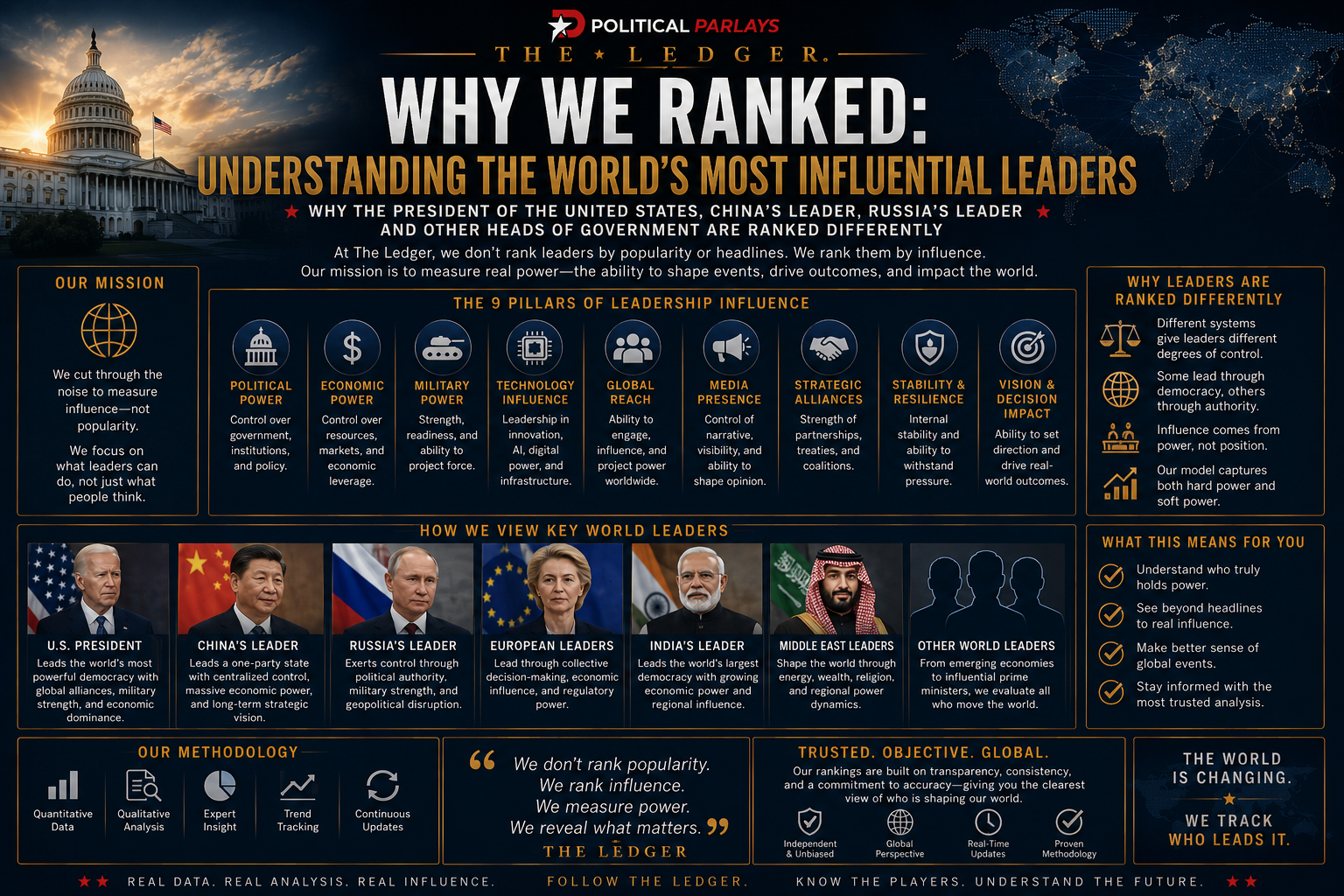
How The Ledger Compares Presidents, Prime Ministers, Monarchs and Heads of State
One of the most common questions readers ask is why one world leader ranks above another.
Why might the President of the United States rank ahead of China’s leader?
Why can India’s Prime Minister rank ahead of another country’s president?
How does Russia’s leader compare with the leaders of other major powers?
The answer begins with understanding what The Ledger is actually measuring.
It is not a popularity contest.
It is not an approval rating.
It is not a measure of who commands the largest military, leads the biggest economy, or receives the most media attention.
Instead, The Ledger asks a broader question:
Which leaders currently possess the greatest ability to influence the future direction of the world?
We Rank Influence, Not Titles
Titles can be misleading.
A president in one country may possess enormous executive authority.
Another president may serve largely as a ceremonial head of state.
A prime minister may wield more practical power than many presidents.
A monarch may possess tremendous symbolic influence while exercising limited constitutional authority.
The Ledger therefore evaluates the authority behind the office, not simply the title attached to it.
The Leader and the Nation Cannot Be Separated
Leadership does not exist in a vacuum.
The influence of a national leader is closely connected to the influence of the country they govern.
For example, the President of the United States currently leads the world’s largest economy by nominal GDP, commands one of the world’s most powerful militaries, oversees the issuer of the dominant reserve currency, and directs a government with extensive alliance networks and global institutional influence. Those factors naturally expand the international reach of the office.
China’s leader operates from a different position of strength.
Xi Jinping oversees the world’s second-largest economy, one of the world’s largest militaries, a leading manufacturing base, and a country that continues to expand its technological, industrial, and geopolitical influence. China’s growing role in global trade, infrastructure, and advanced technology gives its leadership extraordinary international weight.
Russia’s leader governs a nation with a smaller economy than several other major powers, yet Russia remains one of the world’s foremost nuclear powers, an influential energy producer, and a central player in European and global security. Those realities ensure that the office continues to exert significant geopolitical influence beyond what economic size alone would suggest.
India’s Prime Minister leads the world’s most populous nation, one of its fastest-growing major economies, and an increasingly important technology, manufacturing, and diplomatic power. As India’s global role expands, so too does the influence of its leadership.
Personal Leadership Matters
Holding office creates opportunity.
How a leader uses that opportunity determines influence.
Some leaders reshape global alliances.
Some redefine trade relationships.
Some transform domestic economies.
Others become central figures during wars, financial crises, technological revolutions, or geopolitical realignments.
Two individuals occupying the same office at different points in history may exercise dramatically different levels of influence.
The Ledger therefore evaluates both the office itself and the individual currently occupying it.
Influence Changes Over Time
Leadership rankings are among the most dynamic in The Ledger.
An election.
A major war.
A financial crisis.
A breakthrough in artificial intelligence.
A diplomatic agreement.
A technological revolution.
Any of these developments can significantly alter a leader’s influence.
A leader ranked first today may not hold that position in five years.
Likewise, a rising leader may climb rapidly as their country’s influence expands or as global events increase their strategic importance.
The methodology remains consistent.
The rankings evolve with the world.
Influence Is Not Endorsement
A higher ranking should never be interpreted as approval of a leader’s policies, ideology, or style of government.
The Ledger does not rank leaders based on whether they are popular, democratic, authoritarian, liberal, conservative, or aligned with any particular political philosophy.
It measures influence.
Nothing more.
The Ledger Perspective
Every generation produces leaders who shape history in different ways.
Today, figures such as Donald Trump, Xi Jinping, Vladimir Putin, Narendra Modi, and other major heads of government occupy positions that allow them to influence economics, diplomacy, security, technology, trade, and international affairs on a global scale.
Exactly where each leader ranks will change over time as elections, policy decisions, economic performance, international events, and shifts in national influence reshape the world.
That is precisely why The Ledger exists.
Not to create permanent rankings, but to measure how global influence evolves—and to apply the same consistent methodology to every leader, every nation, and every generation.