The Comparison Test
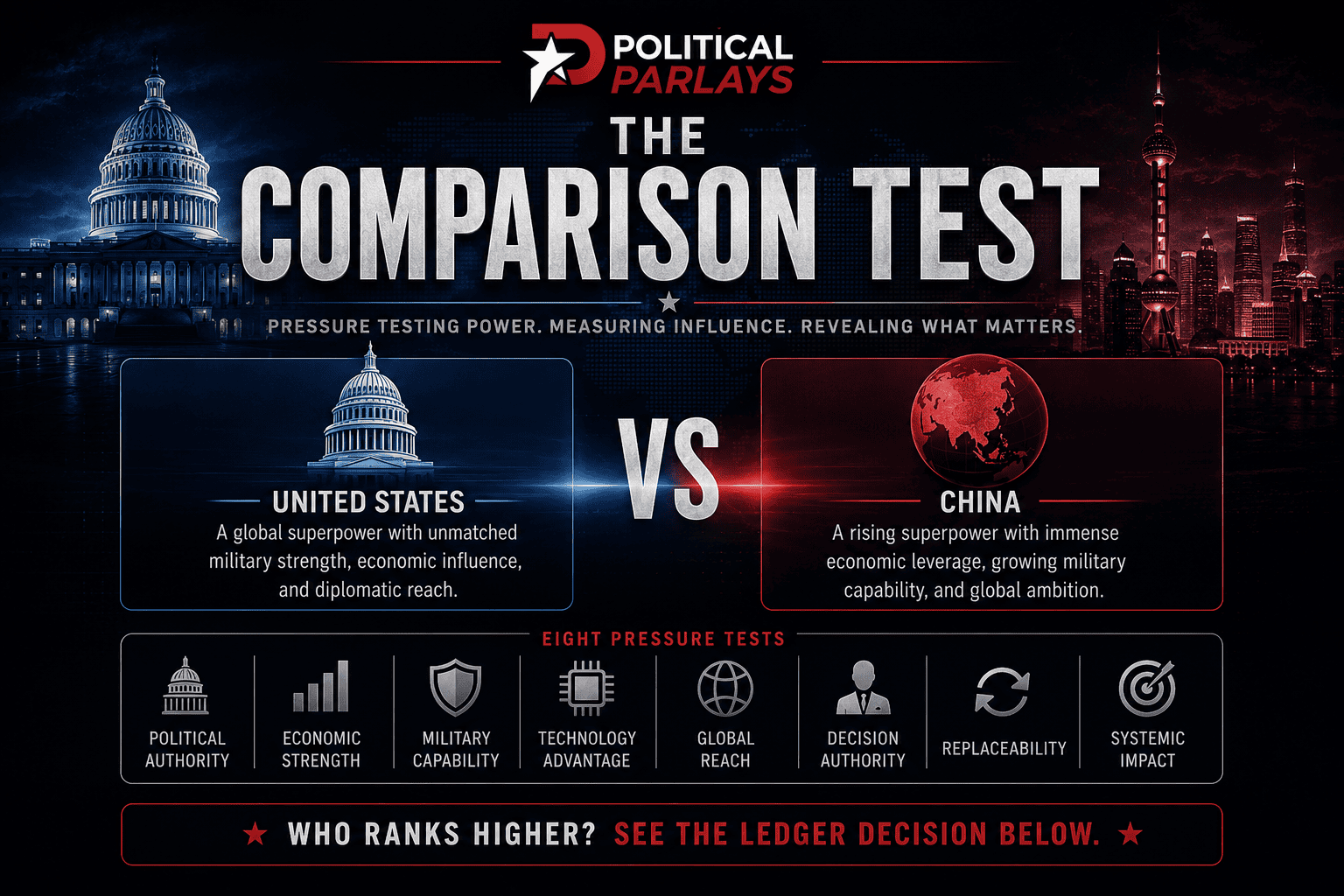
Most rankings simply publish a list.
The Ledger asks a more difficult question:
Can every position be defended?
Rather than treating rankings as fixed opinions, The Ledger compares neighboring entities directly. Every position must prove why it deserves to rank above the entity below it—and why it does not deserve to rank above the entity ahead of it.
This process is known as The Comparison Test.
Every Ranking Is A Head-to-Head Matchup
Imagine two entities standing side by side.
Not by popularity.
Not by headlines.
Not by politics.
But by one question:
Which possesses greater enduring global influence?
The Ledger evaluates both entities using the same methodology before determining which one holds the stronger position.
Example: NATO vs. Russia
At first glance, many people immediately choose Russia because it is one of the world’s largest military powers.
The Comparison Test looks deeper.
Russia possesses significant military capability, natural resources, geopolitical influence, and nuclear deterrence.
NATO, however, represents the combined military, political, economic, and strategic strength of dozens of member nations. Its collective defense commitments, global partnerships, technological capabilities, and institutional coordination create broader and more enduring influence than any single member state.
The Ledger Decision: NATO ranks higher.
Example: BlackRock vs. Saudi Arabia
This comparison surprises many people.
Saudi Arabia is one of the world’s leading energy producers and an influential geopolitical power. It plays a central role in global oil markets, regional security, diplomacy, and international economic policy.
BlackRock, meanwhile, manages trillions of dollars in assets and influences capital allocation, corporate governance, pension funds, sovereign wealth, institutional investment, and financial markets across nearly every major economy.
The question is not which entity is more famous.
The question is:
Which exerts broader and more enduring influence across the global system?
Every comparison must be supported by a consistent methodology—not intuition.
Why Isn’t NVIDIA Ranked Higher?
Questions like this illustrate why The Comparison Test matters.
NVIDIA dominates AI hardware and has become one of the world’s most important technology companies.
Yet governments, central banks, and major international institutions possess authority that extends far beyond technology alone. They influence monetary policy, legislation, defense, diplomacy, regulation, taxation, and the broader global economy.
Innovation creates influence.
Sovereign authority shapes entire systems.
The Comparison Test helps determine where those different forms of influence intersect.
Can You Beat The Ledger?
Every ranking is an invitation to think critically.
Who ranks higher?
BlackRock or Saudi Arabia?
TSMC or Turkey?
NATO or Russia?
Artificial Intelligence or Apple?
Before revealing The Ledger’s decision, ask yourself one question:
Which entity is shaping the world more today?
Then compare your answer with The Ledger.
Why The Comparison Test Matters
The Comparison Test is what separates The Ledger from a traditional ranking.
Rather than asking whether an entity simply belongs somewhere in the Top 100, every position must survive direct comparison with its closest competitors.
Each matchup is evaluated using the same framework and challenged through The Ledger’s Pressure Tests before a final ranking is published.
That’s why every position is intended to be explainable, defensible, and consistent—not just opinion.
Every ranking tells a story.
Every comparison asks a question.
And every answer helps measure who—or what—is shaping the world today.