Political Analysis: Trump’s Second Term
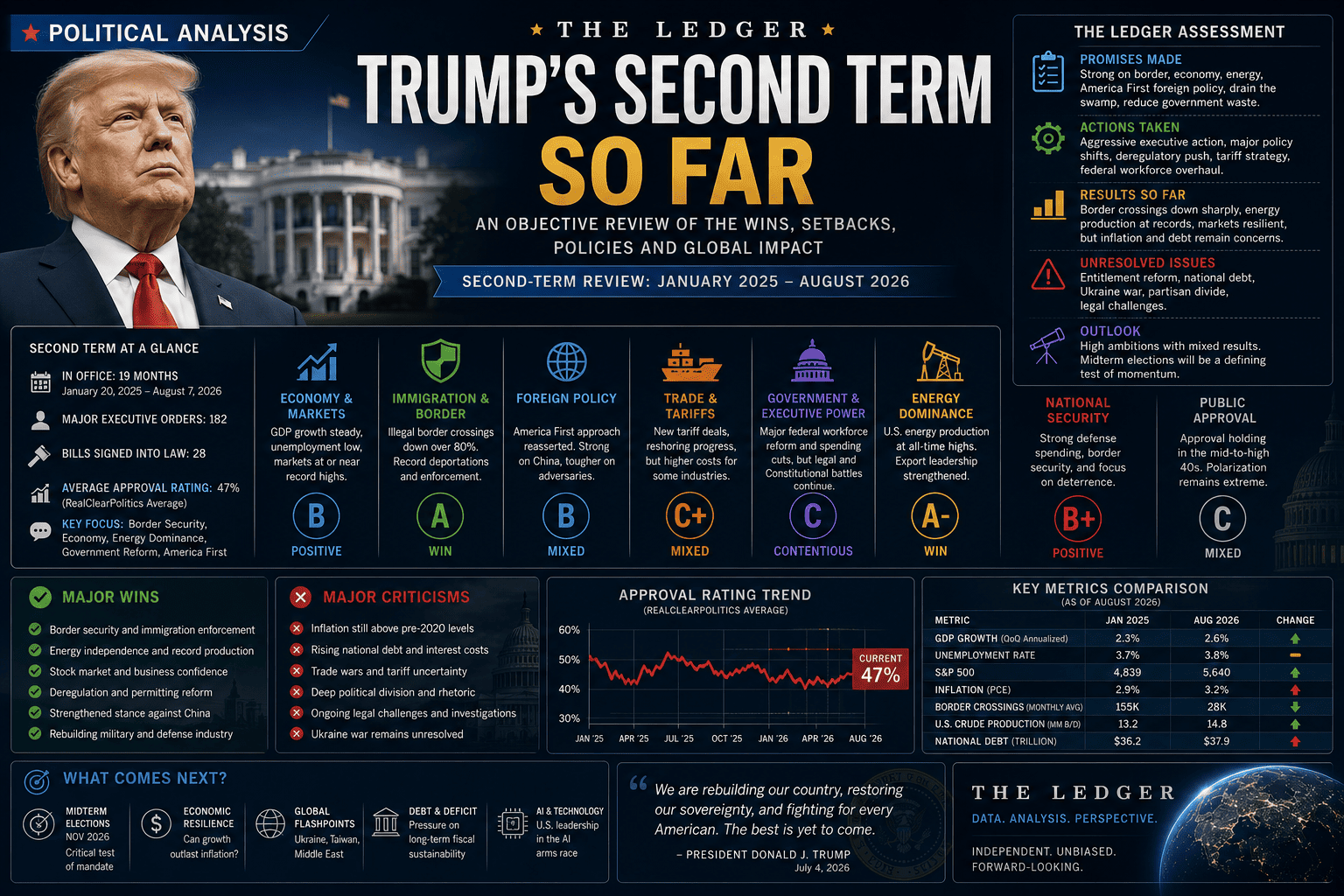
An Overview So Far
An analytical overview of the administration’s second term based on major policy developments, economic performance, foreign affairs and political influence.
Donald Trump’s second presidency has been one of the most consequential and polarizing administrations in modern American politics.
Supporters argue he has moved faster than almost any recent president in implementing campaign promises, particularly on immigration, trade, deregulation and reshaping the federal government.
Critics argue many of those same policies have increased political polarization, generated significant legal challenges and created uncertainty for businesses, allies and financial markets.
Regardless of one’s political perspective, there is little debate that Trump’s second term has fundamentally altered both domestic policy and America’s role in the world.
Border & Immigration
Immigration has remained the defining issue of Trump’s second term.
The administration has expanded deportation efforts, tightened asylum policies, increased interior enforcement and continued pursuing measures intended to reduce illegal immigration. Border crossings have fallen dramatically compared with previous years, while many of the administration’s actions have faced ongoing litigation over their legality and implementation.
Supporters argue:
- Border security has improved significantly.
- Federal immigration laws are being enforced more consistently.
- Reduced illegal immigration strengthens national security and public confidence.
Critics argue:
- Some enforcement policies raise humanitarian and constitutional concerns.
- Courts have repeatedly blocked or narrowed parts of the administration’s agenda.
- Aggressive enforcement may create labor shortages in certain industries.
Trade & Manufacturing
Trump has once again made tariffs a central pillar of economic policy.
The administration argues that stronger trade protections will encourage domestic manufacturing, reduce strategic dependence on foreign supply chains and strengthen industries considered vital to national security, including semiconductors and energy-related manufacturing. New actions have continued to target sectors tied to China, including recent measures involving polysilicon used in chips and solar manufacturing.
Supporters view tariffs as an investment in long-term industrial competitiveness.
Critics argue they increase costs for consumers and businesses while inviting retaliation from trading partners.
The Economy
The economic picture has been mixed.
Financial markets have remained resilient and manufacturing investment has shown signs of improvement in some sectors.
At the same time, many Americans continue to cite inflation and the cost of living as major concerns, and job growth has slowed compared with earlier post-pandemic expansion.
Whether the administration’s trade and industrial policies ultimately produce stronger long-term growth remains one of the central economic questions of the second term.
Foreign Policy
Trump has pursued an “America First” foreign policy that emphasizes national sovereignty, burden-sharing among allies and the use of economic leverage alongside military strength.
The administration has taken a more aggressive approach toward strategic competition with China, expanded the use of tariffs and sanctions, and continued reshaping relationships with allies and international institutions. Ongoing conflicts in Europe and the Middle East have added further complexity to the administration’s foreign-policy agenda.
Supporters believe this approach strengthens American leverage.
Critics argue it can create uncertainty for allies and the broader international system.
Government Reform
Another defining feature of Trump’s second term has been an effort to reduce the size and scope of the federal government.
The administration has sought to streamline agencies, reduce regulation and restructure parts of the federal workforce while emphasizing efficiency and executive control. These efforts have generated praise from those favoring a smaller federal government and criticism from those concerned about institutional capacity and oversight.
Political Position
Trump continues to dominate Republican politics.
His influence over endorsements, fundraising and the direction of the Republican Party remains unusually strong for a second-term president.
That influence extends beyond legislation and executive orders. It shapes candidate recruitment, primary elections and the broader ideological direction of the party.
At the same time, Democrats remain highly motivated in opposition, ensuring that nearly every major initiative produces intense political debate.
The Challenges Ahead
Several questions will likely define the remainder of Trump’s second term:
- Can inflation and the cost of living improve meaningfully?
- Will tariffs strengthen domestic manufacturing without imposing excessive costs?
- Can immigration policies survive continued legal scrutiny?
- How will ongoing geopolitical tensions affect energy prices and global markets?
- Will government restructuring produce lasting efficiencies or unintended consequences?
- How will voters evaluate the administration heading into future national elections?
Political Perspectives
Trump’s second term illustrates why evaluating a presidency requires more than approval ratings or partisan talking points.
Some of his strongest supporters view the administration as delivering on campaign promises that previous presidents were unwilling or unable to pursue.
Some of his strongest critics view the same actions as creating legal, economic or institutional risks that could have lasting consequences.
Both perspectives influence the national conversation.
The ultimate legacy of the administration will likely be judged not only by short-term political victories, but by whether its policies produce durable improvements in economic strength, national security, institutional effectiveness and America’s long-term position in the world.
As with every presidency, that assessment will continue evolving long after the current political cycle ends.